
Blog
Top 10 call centre services for local and global businesses
Call centre services play a crucial role in how businesses interact with their customers. Whether you’re a small local company or a global brand, providing fast, reliable, and professional support directly impacts customer satisfaction and retention.
As customer expectations continue to rise, businesses need to be available across multiple channels and time zones. Managing all of this internally can be complex, which is why outsourcing or using dedicated call centre services has become a smart and scalable solution.
Below are the top 10 call centre services that help businesses improve communication, efficiency, and overall customer experience.
1. Inbound Customer Support
Inbound customer support is the backbone of most call centre operations. It involves handling incoming calls from customers who need help with queries, complaints, billing issues, or product-related concerns. These interactions often shape the customer’s overall perception of your brand.
A well-managed inbound system ensures customers receive quick and accurate responses, which reduces frustration and builds trust. It also allows businesses to maintain consistent service quality across all interactions. Over time, strong inbound support contributes to higher customer satisfaction, loyalty, and long-term retention.
2. Outbound Call Services
Outbound call services focus on reaching out to customers for sales, follow-ups, reminders, and feedback collection. This proactive approach helps businesses stay connected with their audience rather than waiting for customers to initiate contact.
It is widely used for lead generation, appointment setting, and promotional campaigns. When executed effectively, outbound calls can improve conversions and strengthen customer relationships. It also allows businesses to communicate important updates and offers directly to their customers in a personalized way.
3. Technical Support Services
Technical support services help customers resolve issues related to products, systems, or services. These services require trained agents who understand technical details and can guide users step by step toward a solution.
This is especially important for industries like software, telecommunications, and electronics, where customers may face complex problems. Fast and accurate technical support reduces downtime and frustration. It also builds trust, as customers feel confident that help is available whenever they encounter issues.
4. Live Chat Support
Live chat support allows customers to get instant assistance through a website or mobile application. It has become one of the most preferred communication channels because it is quick, convenient, and easy to use.
Agents can handle multiple conversations at the same time, making it efficient for businesses. It also reduces waiting time compared to phone calls and improves response speed. Live chat is particularly useful for handling quick queries and providing real-time support during the customer journey.
5. Email Support Services
Email customer support services are best suited for handling detailed or non-urgent queries that require clear explanations. It allows businesses to provide structured and well-thought-out responses without the pressure of real-time communication.
This method also creates a documented record of conversations, which is helpful for tracking issues and maintaining transparency. Email support is commonly used for handling complaints, account-related concerns, and follow-ups that require proper documentation and clarity.
6. Multilingual Support
Multilingual support enables businesses to communicate with customers in different languages, making interactions more comfortable and effective. This is especially important for companies serving diverse or international markets.
Providing support in a customer’s preferred language reduces misunderstandings and improves overall satisfaction. It also helps businesses expand into new regions by offering a localized experience. This builds trust and strengthens relationships with customers from different backgrounds.
7. Help Desk Services
Help desk services provide structured support through systems that track and manage customer issues efficiently. These services include ticket creation, issue tracking, and escalation processes when needed.
This approach ensures that every customer request is recorded and handled properly. It is particularly useful for businesses dealing with a high volume of queries, as it improves organization and accountability. A strong help desk system leads to faster resolution times and better service quality.
8. Order Taking and Processing
Order taking services and processing help businesses manage customer purchases, bookings, and transactions smoothly. Agents assist customers in placing orders, confirming details, and ensuring everything is handled correctly.
This service is widely used in industries like e-commerce, retail, and healthcare. It reduces errors, speeds up transactions, and improves overall efficiency. Proper order handling also enhances customer experience by ensuring accuracy and timely processing.
9. Customer Feedback and Survey Services
Customer feedback services focus on collecting insights directly from customers through surveys, follow-up calls, or feedback campaigns. This helps businesses understand customer satisfaction and identify areas for improvement.
The information gathered can be used to improve products, services, and overall operations. It also shows customers that their opinions are valued, which strengthens trust and engagement. Regular feedback collection helps businesses stay aligned with customer expectations.
10. 24/7 Customer Support
24/7 customer support ensures that customers can reach your business at any time, regardless of their location or time zone. This is essential for businesses that operate across multiple regions or serve a global audience.
Providing round-the-clock support improves accessibility and builds reliability. Customers feel more confident knowing help is always available when needed. It also gives businesses a competitive advantage by offering uninterrupted service and faster issue resolution.
Conclusion: Choosing the Right Call Centre Services
Choosing the right call centre services depends on your business goals, customer expectations, and operational requirements. While some businesses may only need basic support, others benefit from a combination of multiple services working together.
The key is to focus on services that improve efficiency, enhance customer experience, and support long-term growth. With the right mix of services, businesses can build strong customer relationships and create a reliable support system that drives success.

Most Useful Call Center Services for E-commerce Businesses
Running an e-commerce business means dealing with customers at every step—before buying, during checkout, and after delivery. Managing all these conversations can become difficult, especially when your business starts growing. This is where call center services become very useful.
They help you respond quickly, solve problems easily, and keep your customers satisfied. In this guide, you will clearly understand which services matter the most for e-commerce and how they help your business grow smoothly and simply.
Call Center Services Explained for E-commerce in a Simple Way
In simple words, call center services help you manage all your customer communication in one organized system.
Instead of missing messages or replying late, these services make sure every customer gets a proper and timely response. Whether it is about products, orders, or complaints, everything is handled in a structured way.
For an e-commerce business, communication is everything. If customers don’t get support, they may leave and never come back.
Why E-commerce Businesses Need Strong Customer Support Systems
Online businesses don’t have face-to-face interaction, so communication becomes the main way to build trust with customers.
If a customer faces an issue and doesn’t get help quickly, it can lead to cancellations or negative reviews. On the other hand, fast and helpful responses build confidence and increase repeat purchases.
A strong support system ensures your business stays reliable, even during busy times like sales or festive seasons.
Order Handling and Processing Support That Reduces Errors
Order management is one of the most important parts of any e-commerce business. Even small mistakes can create big problems.
With proper support, your business can:
- Confirm orders quickly and accurately
- Handle high order volumes without confusion
- Manage order changes easily
- Reduce mistakes in processing
This makes your operations smoother and helps you avoid customer complaints. A well-managed order system also saves time and improves overall efficiency.
Customer Support for Pre-Sales and Post-Sales Queries
Customers often have questions before buying and sometimes even after receiving their product. Handling these queries properly is very important.
A good support system helps answer product-related questions, guide customers in making decisions, and solve problems after delivery. This creates a better experience and builds long-term trust.
When customers feel supported at every stage, they are more likely to return and recommend your business to others.
Returns and Refund Management Made Simple and Clear
Returns and refunds are common in e-commerce, but they can be difficult to manage without proper support.
A clear and simple process helps customers understand what to do if they want to return a product. It also reduces confusion and frustration.
Handling returns professionally improves your brand image. Even if a customer is unhappy at first, a smooth refund process can turn the experience into a positive one.
How Call Centers Improve Lead Generation and Sales
A good support system not only solves problems but also helps increase sales.
With the right setup, your business can:
Guide customers in choosing the right product
Answer doubts quickly to avoid hesitation
Encourage customers to complete their purchase
Capture interest from new visitors
This improves your lead generation and increases your chances of converting visitors into customers. Good communication always leads to better results.
Multichannel Support for Better Customer Experience
Customers today use different platforms to contact businesses. Some prefer calls, while others use chat, email, or social media.
A strong system brings all these channels together so you can manage everything from one place. This ensures no message is missed and every customer gets a response.
Providing support across multiple channels makes your business more accessible and improves the overall experience.
Important Features You Should Expect from Call Center Services
Before choosing any service, make sure it includes features that actually help your business run smoothly.
Some key features include:
- Fast and reliable response handling
- Order tracking and updates
- Customer data management
- Real-time performance tracking
- Integration with your e-commerce platform
These features help you stay organized and manage customer communication more effectively. Simple tools that solve real problems are always the best choice.
Common Mistakes E-commerce Businesses Should Avoid
Many e-commerce businesses face problems because they ignore customer support or choose the wrong approach.
Some common mistakes include:
- Delaying responses to customer queries
- Making return processes complicated
- Not tracking customer communication
- Ignoring customer feedback
Avoiding these mistakes helps you build a better customer experience and prevents unnecessary issues in your business operations.
Real Benefits You Will Notice After Using the Right Services
Once you start using proper call center services, you will see clear improvements in your daily operations.
- Faster responses to customer queries
- Better order management
- Improved customer satisfaction
- Increased repeat purchases
These benefits help your business grow in a stable and consistent way. Strong communication always leads to better customer relationships.
Frequently Asked Questions (FAQs)
What are the most useful call center services for e-commerce businesses?
Order handling, customer support, return management, and multichannel communication are the most important services for online businesses.
How do call center services improve customer experience?
They provide quick responses, clear communication, and effective problem-solving, which makes customers feel supported and valued.
Can call center services help increase sales?
Yes, they guide customers, answer questions quickly, and help in better decision-making, which increases conversions and supports lead generation.
Are call center services necessary for small e-commerce stores?
Yes, even small stores need strong communication systems to build trust and improve customer satisfaction.
How do I choose the right call center services for my store?
Focus on your needs, choose simple and reliable options, and make sure they support your business processes.
Conclusion
Using the right call center services can completely improve how your e-commerce business works. From handling orders to solving customer problems, everything becomes easier and more organized. It helps you build trust, improve customer experience, and support your lead generation without extra effort. You don’t need to make things complicated—just choose what fits your needs. When your communication is strong, your business naturally grows faster and more successfully.
Impact of AI on Contact Centers in St. Lucia [2026]
The role of technology in customer support is evolving rapidly, and in 2026, artificial intelligence is transforming how businesses operate. Contact Centers in St Lucia are increasingly adopting AI to improve efficiency, reduce operational costs, and deliver faster, more personalized customer experiences. This shift is not just about automation—it is about enhancing the overall quality of service while maintaining human connection. As global demand for smarter and more scalable support solutions grows, St. Lucia is positioning itself as a competitive destination for modern contact center services. In this article, you’ll understand how AI is impacting contact centers in St. Lucia, what changes businesses can expect, and why this transformation matters for future customer support strategies. AI-Powered Automation Is Improving Efficiency AI is helping contact centers in St. Lucia automate repetitive and time-consuming tasks such as call routeing, data entry, and basic customer queries. This reduces the workload on human agents and allows them to focus on more complex and high-value interactions. Automation also improves response speed, ensuring that customers receive immediate assistance for simple issues. This creates a smoother and more efficient support process. For businesses, this means lower operational costs and higher productivity. It also ensures better resource utilisation without compromising service quality. Smarter Customer Interactions with AI Tools AI tools such as chatbots and virtual assistants are being widely used in contact centers in St Lucia. These tools can handle common customer queries, provide instant responses, and guide users through basic processes. They are available 24/7, which ensures continuous support even outside regular working hours. This improves accessibility and customer convenience. For businesses, this leads to better engagement and faster resolution times. It also enhances the overall customer experience by providing immediate assistance. Enhanced Personalization in Customer Support AI customer support services allows contact centers in St. Lucia to deliver more personalized customer experiences. By analyzing customer data and previous interactions, AI systems can provide tailored responses and recommendations. This helps agents understand customer needs more effectively and offer relevant solutions. It also creates a more engaging and satisfying experience for customers. For businesses, personalization leads to higher customer satisfaction and loyalty. It also increases the chances of repeat business and long-term relationships. Improved Decision-Making with Data Insights AI systems can analyze large amounts of customer data in real time. Contact centers in St. Lucia use these insights to understand customer behavior, identify trends, and improve service strategies. This data-driven approach helps businesses make better decisions. It allows them to optimize processes, improve performance, and address issues more effectively. For businesses, this means continuous improvement in customer support. It also helps in planning and forecasting future needs. Better Workforce Management AI is also improving how contact centers in St. Lucia manage their workforce. It helps in scheduling, performance tracking, and workload distribution. Managers can use AI tools to predict call volumes and allocate resources accordingly. This ensures that there are enough agents available during peak times. For businesses, this leads to improved efficiency and reduced operational challenges. It also helps maintain consistent service quality. Balancing AI and Human Support While AI brings many benefits, human interaction remains essential in customer support. Contact centers in St. Lucia are focusing on balancing automation with human involvement. AI handles routine tasks, while human agents manage complex and sensitive issues. This combination ensures both efficiency and empathy in customer interactions. For businesses, this creates a more complete support system. It ensures that customers receive both fast responses and personalized care when needed. Challenges of AI Adoption Despite its advantages, adopting AI in contact centers in St. Lucia comes with challenges. Initial setup costs and training requirements can be high for some businesses. There may also be concerns about over-reliance on automation. Poor implementation can lead to negative customer experiences if not managed properly. For businesses, it is important to implement AI strategically. Proper planning and integration ensure that AI delivers maximum value without affecting service quality. Growing Opportunities for St. Lucia The adoption of AI is creating new opportunities for contact centers in St. Lucia. It is helping the region attract global businesses looking for advanced and efficient support solutions. With the right investment in technology and training, St. Lucia can strengthen its position in the global outsourcing market. AI is playing a key role in this growth. For businesses, this means access to modern, scalable, and high-quality support services. It also opens doors to innovation and long-term success. Final Thoughts The impact of AI on contact centers in St. Lucia in 2026 is both significant and transformative. From improving efficiency and personalization to enabling better decision-making, AI is reshaping how customer support is delivered. By combining advanced technology with skilled human agents, contact centers in St. Lucia are creating a balanced and effective support system. This not only improves customer experience but also helps businesses operate more efficiently. As AI continues to evolve, its role in customer support will only grow stronger. Businesses that adapt to these changes will be better positioned to deliver high-quality service and stay competitive in the global market.
The Role of AI in Customer Support: 2026 Perspective
In 2026, artificial intelligence (AI) has become a core component of modern customer support. Businesses are increasingly leveraging AI alongside traditional call centers and contact centers to provide faster, more accurate, and more personalized service. By automating routine tasks, analyzing customer behavior, and assisting human agents in real-time, AI is transforming how companies engage with their customers.
Understanding the role of AI in customer support helps businesses make smarter decisions about outsourcing, staffing, and technology investments. This guide explores how AI works in customer service, the benefits it brings, and its integration with outsourced contact centers.
How AI Supports Customer Support
AI customer support enhances customer support in multiple ways. Chatbots and virtual assistants can manage basic inquiries instantly, freeing human agents to focus on complex problems. AI-powered tools analyze customer interactions to identify trends, predict recurring issues, and suggest optimal solutions.
By integrating AI with contact centers, companies can provide 24/7 support without increasing operational costs significantly. AI can triage tickets, route calls to the right agents, and even assist agents during live interactions by suggesting answers or highlighting previous customer interactions. This combination of AI and human expertise improves efficiency, accuracy, and customer satisfaction.
Benefits of AI in Customer Support
AI adoption brings several advantages to customer service operations:
Faster Response Times: AI can handle routine inquiries instantly, reducing wait times.
Consistent Service Quality: Automated responses ensure that standard information is always accurate.
Improved Agent Productivity: Human agents can focus on complex, high-value tasks instead of repetitive issues.
Data-Driven Insights: AI analyzes interactions to identify patterns, improve processes, and predict customer needs.
Scalability: AI enables businesses to handle peak volumes without hiring additional staff, providing flexibility.
Integration with Outsourced Contact Centers
Many outsourced contact centers in 2026 combine AI with human agents to deliver seamless customer experiences. AI manages basic inquiries, ticket management, and call routing, while skilled agents handle complex issues and personalized interactions.
This hybrid approach allows businesses to maintain high-quality service while optimizing costs and efficiency. Companies can scale operations globally, provide multilingual support, and maintain 24/7 service without the limitations of human-only teams.
Personalization Through AI
One of the most transformative roles of AI in customer support is personalization. AI systems analyze customer data such as past interactions, purchase history, and preferences to provide tailored recommendations and solutions.
For example, when a customer contacts a support line, AI can present the agent with relevant information about the customer’s previous issues, preferred products, or subscription plans. This enables agents to provide faster, more precise, and highly personalized service, improving customer loyalty and satisfaction.
Cost Optimization and Efficiency
AI reduces operational costs by automating repetitive tasks and streamlining workflows. Businesses no longer need to hire additional staff for routine queries, yet they can maintain consistent, high-quality service. By optimizing call handling, reducing resolution time, and improving agent productivity, AI helps companies deliver better service without proportionally increasing expenses.
Cost savings also allow companies to reinvest in other areas, such as training human agents, upgrading technology, or expanding business operations, which further enhances overall customer experience.
Future Trends of AI in Customer Support
The role of AI continues to evolve rapidly. In 2026, key trends include:
Predictive Analytics: Anticipating customer issues before they arise.
Sentiment Analysis: Understanding customer emotions to provide empathetic responses.
Natural Language Processing (NLP): Allowing AI to understand complex queries and converse naturally.
Omnichannel AI Support: Coordinating service across calls, chat, social media, and emails seamlessly.
Intelligent Automation: Automating workflows and escalations to reduce manual intervention.
These trends indicate that AI will become even more integral to customer support, offering proactive solutions and a more intuitive customer experience.
Conclusion
AI is transforming customer support by enabling faster, smarter, and more scalable service. Combined with outsourced contact centers, AI enhances agent performance, streamlines operations, and improves customer satisfaction.
Businesses that embrace AI in 2026 can offer both efficiency and empathy in every interaction, ensuring that customers feel valued while reducing operational burdens. The integration of AI is no longer optional—it is a strategic necessity for modern customer support.
FAQs
How does AI help customer support teams?
AI handles routine inquiries, assists agents in real time, analyzes customer data, and provides insights for faster, more accurate service.
Can AI replace human agents in customer support?
No. AI complements human agents by managing repetitive tasks while humans handle complex, nuanced interactions requiring empathy and judgment.
How does AI improve customer satisfaction?
By reducing response times, providing consistent answers, and enabling personalized service, AI enhances overall customer experience.
Can AI work with outsourced contact centers?
Yes. Many modern outsourced contact centers integrate AI to improve efficiency, optimize workflows, and provide 24/7 support.
What are future trends of AI in customer support?
Predictive analytics, sentiment analysis, natural language processing, and personalized recommendations are key areas driving AI adoption in 2026 and beyond.
Top Call Center’s Best Lead Generation Strategies [2026 Updated]
Generating leads for a call center isn’t about chasing traffic or posting random content. It’s about attracting businesses that already need customer support, telemarketing, or outsourced sales help and guiding them straight to a conversation.
In 2026, buyers research more, compare faster, and only talk to vendors they trust. That means your lead generation must be targeted, credible, and conversion-focused from day one.
SEO for High-Intent Service Keywords
Most call centers deals start with Google. Decision-makers search terms like “outsourced customer support company,” “inbound call center services,” or “b2b telemarketing company” not generic phrases like “call center tips.” Ranking for these high-intent keywords brings prospects who are already ready to buy.
Build dedicated service pages for each offering instead of one general page. Optimize titles, headings, and content around clear problems and solutions. Add pricing signals, use cases, and FAQs so visitors don’t need to leave your site for answers. When your pages match exactly what they search, conversions increase naturally.
LinkedIn Outreach to Decision Makers
LinkedIn remains one of the strongest B2B Lead Generation sources for call centers. Your buyers are operations managers, founders, and CX heads, and most of them are active there daily. Instead of mass messaging, focus on targeted outreach with relevance.
Optimize your company profile with clear services and proof. Connect with prospects in industries you serve best, then start conversations around their challenges, not your pitch. Share insights, case studies, and results regularly. Warm conversations consistently outperform cold ads.
Cold Calling and Email Prospecting (Done Right)
Cold outreach still works extremely well for call centers because you already specialize in communication. The key difference in 2026 is personalization. Generic scripts get ignored.
Segment your list by industry and tailor your message to each segment. Mention their business model, growth stage, or current support gaps. Keep calls short and focused on booking meetings, not selling services immediately. When combined with a clean CRM and steady follow-ups, this channel delivers predictable leads every month.
Content Marketing That Solves Real Problems
Businesses don’t hire call centers blindly. They research costs, processes, and risks first. Helpful content builds trust before the first call. Write articles, guides, and comparisons that answer practical questions like pricing, outsourcing models, and ROI expectations.
Focus on clarity and real experience, not theory. Add examples, numbers, and simple explanations. When prospects see that you understand their problems deeply, they naturally reach out. Good content turns your website into a 24/7 salesperson.
Case Studies and Proof of Results
Nothing convinces buyers faster than real results. Case studies show what actually happens after they sign with you. This reduces risk and shortens the sales cycle significantly.
Show the client’s problem, your solution, and measurable outcomes like reduced costs, faster response times, or higher conversions. Keep them simple and honest. Add testimonials, screenshots, or metrics where possible. Proof builds more trust than any marketing claim.
Paid Ads for Immediate Lead Flow
SEO and content take time, but paid ads can generate leads quickly. Platforms like Google Ads and LinkedIn Ads work well when you target high-intent searches and specific industries.
Send traffic to focused landing pages, not your homepage. Keep one clear message and one action, usually booking a consultation. Track every click and cost per lead so you know what’s profitable. With the right targeting, ads can scale your pipeline fast.
Partnerships and Referral Networks
Strategic partnerships can bring steady, low-cost leads. Many agencies and consultants already work with your ideal clients but don’t offer call center services themselves. These partners can refer business regularly.
Connect with BPO consultants, digital marketing agencies, SaaS providers, and HR firms. Offer referral fees or bundled solutions. A strong partner network often delivers warmer leads than any paid channel because trust already exists.
Landing Pages Built Only for Conversions
Many call center websites look informative but don’t convert well. Dedicated landing pages change that. Each campaign should have a page designed only to capture inquiries.
Remove distractions like extra menus or links. Highlight benefits, proof, and a clear call-to-action. Add simple forms or direct call buttons. When visitors have fewer choices, they act faster. Small design changes can double your lead rate.
Lead Magnets and Contact Capture
Not every visitor is ready to talk immediately. Lead magnets help you capture early-stage prospects and nurture them later. Offer something valuable in exchange for their contact details.
Useful examples include pricing guides, outsourcing checklists, or “how to choose a call center” reports. Follow up with helpful emails that educate rather than sell aggressively. Over time, these contacts convert into qualified opportunities.
CRM Tracking and Follow-Up Systems
Many call centers lose leads simply because follow-ups are inconsistent. A structured CRM process ensures every inquiry is tracked and contacted multiple times.
Set reminders, automate emails, and monitor response times. Measure where leads drop off and fix those gaps. Lead generation doesn’t end at capture; consistent follow-up is what turns interest into contracts.
Final Thoughts
Lead generation for call centers works best when it’s focused, practical, and measurable. Instead of chasing every tactic, choose a few proven strategies, execute them consistently, and optimize based on data. When your marketing speaks directly to real business problems, leads stop feeling random and start becoming predictable.
Frequently Asked Questions
Which channel brings the fastest results?
Paid ads and cold outreach usually generate leads quickest, while SEO and content build long-term stability.
Is SEO worth it for call centers?
Yes. High-intent search traffic converts extremely well because visitors already want outsourced support.
How many channels should we use at once?
Start with two or three strong channels, then scale after you see consistent results.
Do small call centers need marketing too?
Absolutely. Even smaller teams can compete by focusing on a niche and targeted outreach.
What’s the biggest mistake agencies make?
Relying on one source only. Diversification keeps your pipeline steady.
How Call Centers Support BPO Companies
Business Process Outsourcing (BPO) companies manage a wide range of business functions for their clients, including customer service, data processing, technical support, and administrative tasks. Among these functions, call centers play a critical role. They act as the frontline communication channel between businesses and their customers. Call centers do not operate in isolation; instead, they actively support and strengthen BPO companies by enabling smooth communication, efficient process execution, and scalable service delivery.
Without call centers, most BPO operations would struggle to meet client expectations and handle growing workloads effectively.
Call Centers Act as the Primary Communication Channel
One of the most important ways call centers support BPO companies is by handling direct communication with customers, clients, and end users. BPO companies often manage backend processes, but customers still need a reliable point of contact for queries, issues, and support.
Call centers manage inbound and outbound calls, customer inquiries, follow-ups, and service requests. This direct interaction ensures that information flows smoothly between customers and BPO systems. Clear communication reduces misunderstandings, speeds up problem resolution, and improves overall service quality.
Call Centers Help BPO Companies Deliver End-to-End Services
Many clients choose BPO companies because they want complete solutions, not fragmented services. Call centers help BPO companies offer end-to-end service delivery by connecting customer interactions with backend processes.
For example, when a customer raises a request, call center agents capture the details and pass them to BPO teams for processing. Once the task is completed, the call center communicates updates or results back to the customer. This seamless coordination allows BPO companies to manage entire workflows efficiently.
Call Centers Support High-Volume Workloads Efficiently
BPO companies often deal with large volumes of transactions, requests, and service interactions. Managing these volumes without a structured communication system can lead to delays and errors. Call centers are designed to handle high call volumes through trained agents, queue management systems, and performance tracking tools.
By managing large-scale communication efficiently, call centers help BPO companies maintain service levels even during peak demand periods. This capability is especially important for industries with seasonal spikes or time-sensitive operations.
Call Centers Improve Customer Experience for BPO Clients
Customer experience is a key factor in the success of any BPO company. Even if backend processes are efficient, poor communication can damage client trust. Call centers ensure that customers receive timely responses, clear explanations, and consistent support.
Well-trained call center agents represent the BPO company professionally. They follow defined scripts, quality standards, and escalation processes. This structured approach helps BPO companies maintain a positive brand image and meet client expectations.
Call Centers Enable Faster Issue Resolution
Many customer issues require immediate attention. Call centers allow BPO companies to respond quickly by providing real-time support. Agents can access customer data, verify details, and escalate issues to the appropriate BPO teams without delay.
Fast issue resolution reduces customer frustration and prevents small problems from becoming larger complaints. This responsiveness strengthens client relationships and improves Customer service reliability.
Call Centers Support Data Collection and Process Accuracy
Every customer interaction generates valuable data. Call centers capture information such as customer feedback, service requests, complaints, and preferences. This data is passed to BPO teams for processing, analysis, and reporting.
Accurate data collection helps BPO companies improve processes, identify recurring issues, and optimize service delivery. Call centers play a crucial role in ensuring that this information is recorded correctly and consistently.
Learn more about The Importance of Accurate Data Handling in Call Centers.
Call Centers Help BPO Companies Scale Operations
Scalability is a major advantage of the BPO model. Call centers support this scalability by allowing BPO companies to increase or reduce support capacity based on demand. Additional agents can be trained and deployed quickly without disrupting existing operations.
This flexibility allows BPO companies to onboard new clients, expand service offerings, and enter new markets. Call centers provide the communication infrastructure needed to support this growth smoothly.
Call Centers Reduce Operational Pressure on BPO Teams
Without call centers, BPO teams would need to handle both backend processing and customer communication. This dual responsibility can reduce efficiency and increase errors. Call centers take over communication tasks, allowing BPO teams to focus on core processes.
This separation of roles improves productivity and ensures that each team works within its area of expertise. As a result, overall service quality improves across the organization.
Call Centers Support Compliance and Quality Standards
Many BPO companies serve industries that require strict compliance with regulations and service-level agreements. Call centers help enforce these standards by following defined procedures, maintaining call records, and monitoring agent performance.
Quality assurance processes in call centers ensure consistent communication and accurate information sharing. This support helps BPO companies meet contractual obligations and regulatory requirements.
Call Centers Strengthen Client Trust and Long-Term Partnerships
Clients rely on BPO companies to represent their business professionally. Call centers act as the voice of the client organization. Clear communication, polite interactions, and reliable support build trust with end customers.
Strong call center performance reflects positively on the BPO company and its clients. This trust leads to long-term partnerships, contract renewals, and business growth.
Conclusion: The Strategic Role of Call Centers in BPO Operations
Call centers are a foundational support system for BPO companies. They manage customer communication, support backend processes, improve efficiency, and enable scalability. By handling high-volume interactions, collecting accurate data, and maintaining service quality, call centers allow BPO companies to deliver complete and reliable outsourcing solutions. In today’s competitive outsourcing environment, the success of a BPO company is closely tied to the strength and effectiveness of its call center operations.
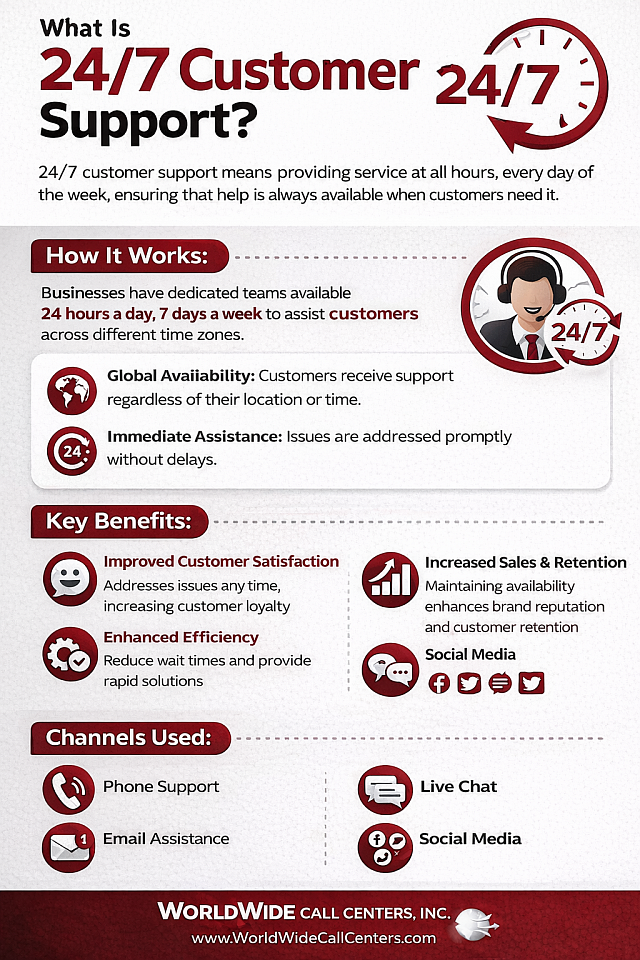
What Is 24/7 Customer Support and Why It Matters
This visual explains what 24/7 customer support means and how businesses use it to assist customers at any time. It outlines how round-the-clock customer support operates, the common communication channels involved, and why always-available customer support is becoming important for modern businesses.